Edge Computing and Cloud: Why It Matters for the Future of Digital Infrastructure
Edge computing and cloud computing are no longer competing architectures. Together, they form the backbone of modern digital systems that demand speed, resilience, scalability, and intelligence at scale. As data generation accelerates at the edge—through IoT devices, sensors, and real-time applications—the convergence of edge and cloud is becoming a strategic necessity rather than a technical choice.
Table of Contents
- What Is Edge Computing and Cloud Computing?
- Why the Shift Toward Edge-Cloud Architectures
- Latency, Performance, and Real-Time Intelligence
- Security, Privacy, and Data Sovereignty
- Key Industry Use Cases Driving Adoption
- How Edge and Cloud Work Together
- Business Value and Strategic Impact
- Challenges and Limitations
- The Future of Edge-Cloud Convergence
- Top 5 Frequently Asked Questions
- Final Thoughts
- Resources
What Is Edge Computing and Cloud Computing?
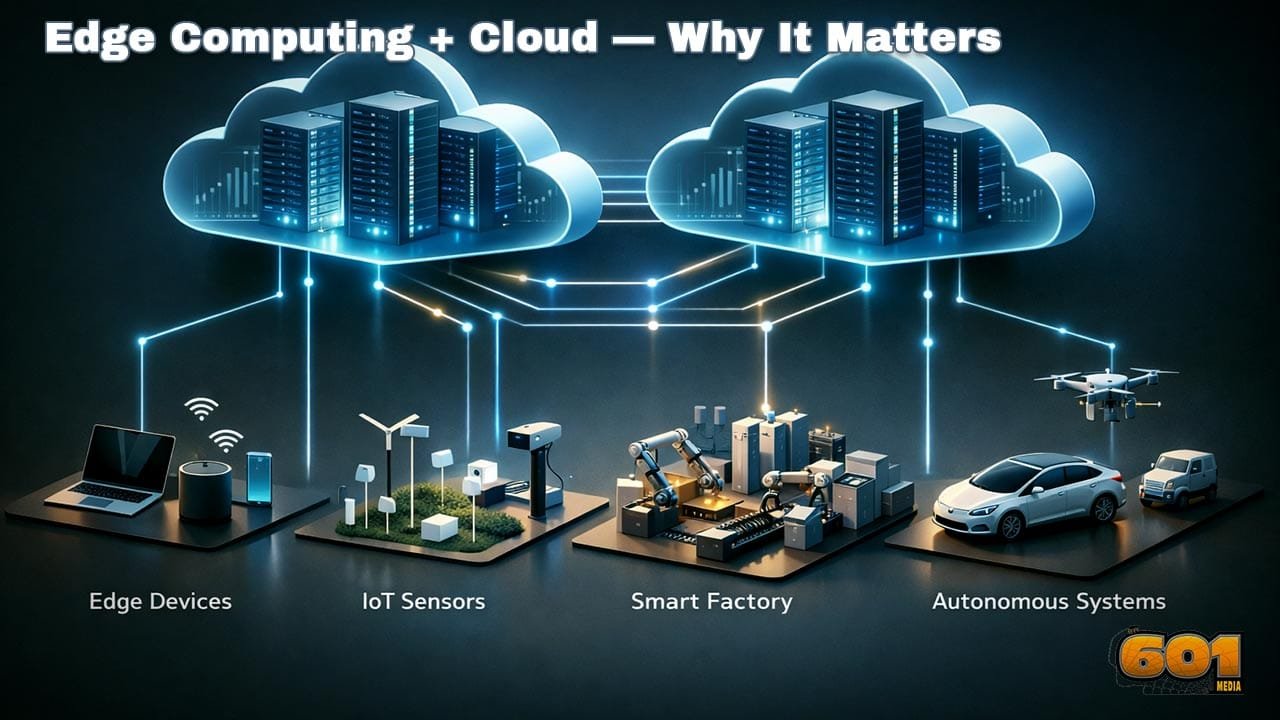
Cloud computing centralizes compute, storage, and analytics in large-scale data centers. It excels at elastic scalability, deep analytics, and long-term data storage. Edge computing, by contrast, processes data closer to where it is generated—on devices, gateways, or local micro data centers. The distinction is not binary. Edge reduces the need to send every data point to the cloud, while the cloud provides centralized intelligence, orchestration, and historical insight. Together, they form a distributed continuum of compute.
Why the Shift Toward Edge-Cloud Architectures
According to industry estimates, over 75% of enterprise data will be created outside centralized data centers by the end of the decade. This shift is driven by IoT proliferation, video analytics, autonomous systems, and 5G networks. Sending all this data to the cloud is inefficient, costly, and often impractical. Edge computing filters, preprocesses, and acts on data locally, sending only high-value insights to the cloud. This architecture reduces bandwidth consumption and enables faster decision-making.
Latency, Performance, and Real-Time Intelligence
Latency is the most immediate driver of edge adoption. Applications such as autonomous vehicles, industrial robotics, augmented reality, and smart grids require response times measured in milliseconds. Cloud-only architectures introduce unavoidable delays due to network distance. Edge computing eliminates round-trip latency, allowing systems to react in real time while still leveraging the cloud for model training, optimization, and coordination.
Security, Privacy, and Data Sovereignty
Data privacy regulations and security concerns increasingly shape infrastructure decisions. Processing sensitive data locally at the edge reduces exposure risk and helps organizations comply with regional data sovereignty laws. Edge-cloud architectures support a “local-first” security model where raw data remains on-site while anonymized or aggregated insights move to the cloud. This layered approach strengthens resilience against breaches and outages.
Key Industry Use Cases Driving Adoption
Manufacturing uses edge computing for predictive maintenance and quality inspection. Retail applies it for real-time inventory tracking and customer analytics. Healthcare relies on it for patient monitoring and diagnostics at the point of care. In each case, the cloud provides centralized analytics and AI training, while the edge delivers immediate action. The value comes from orchestration, not isolation.
How Edge and Cloud Work Together
Modern architectures treat edge nodes as extensions of the cloud rather than standalone systems. Centralized cloud platforms manage deployment, updates, monitoring, and AI model distribution across thousands of edge locations. Data flows bidirectionally. The edge executes inference and control, while the cloud aggregates insights, retrains models, and optimizes global performance. This feedback loop enables continuous improvement at scale.
Business Value and Strategic Impact
Edge-cloud convergence delivers measurable business outcomes. Organizations report lower operational costs, improved uptime, faster innovation cycles, and better customer experiences. From a strategic perspective, it enables new revenue models such as usage-based services, real-time personalization, and autonomous operations. Companies that master this architecture gain agility that traditional IT models cannot match.
Challenges and Limitations
Despite its benefits, edge computing introduces complexity. Managing distributed infrastructure, ensuring consistent security policies, and maintaining observability across environments remain significant challenges. Skills gaps and tooling fragmentation also slow adoption. Success requires disciplined architecture design, strong governance, and investment in automation.
The Future of Edge-Cloud Convergence
The future points toward seamless compute fabrics where workloads dynamically move between edge and cloud based on latency, cost, and compliance needs. Advances in AI orchestration, containerization, and networking will make this transition increasingly invisible to end users. Edge computing will not replace the cloud. Instead, it will redefine it—extending intelligence outward to where the real world meets digital systems.
Top 5 Frequently Asked Questions
Final Thoughts
The convergence of edge computing and cloud computing represents a structural shift in how digital systems are designed and operated. The most successful organizations will be those that view infrastructure not as a location, but as a capability—distributed, intelligent, and adaptive. Edge plus cloud is not a trend. It is the foundation of next-generation digital transformation.
Resources
- Gartner – Edge Computing Market Insights
- IDC – Worldwide Edge Spending Guide
- McKinsey – The Value of Edge Computing

I am a huge enthusiast for Computers, AI, SEO-SEM, VFX, and Digital Audio-Graphics-Video. I’m a digital entrepreneur since 1992. Articles include AI researched information. Always Keep Learning! Notice: All content is published for educational and entertainment purposes only. NOT LIFE, HEALTH, SURVIVAL, FINANCIAL, BUSINESS, LEGAL OR ANY OTHER ADVICE. Learn more about Mark Mayo