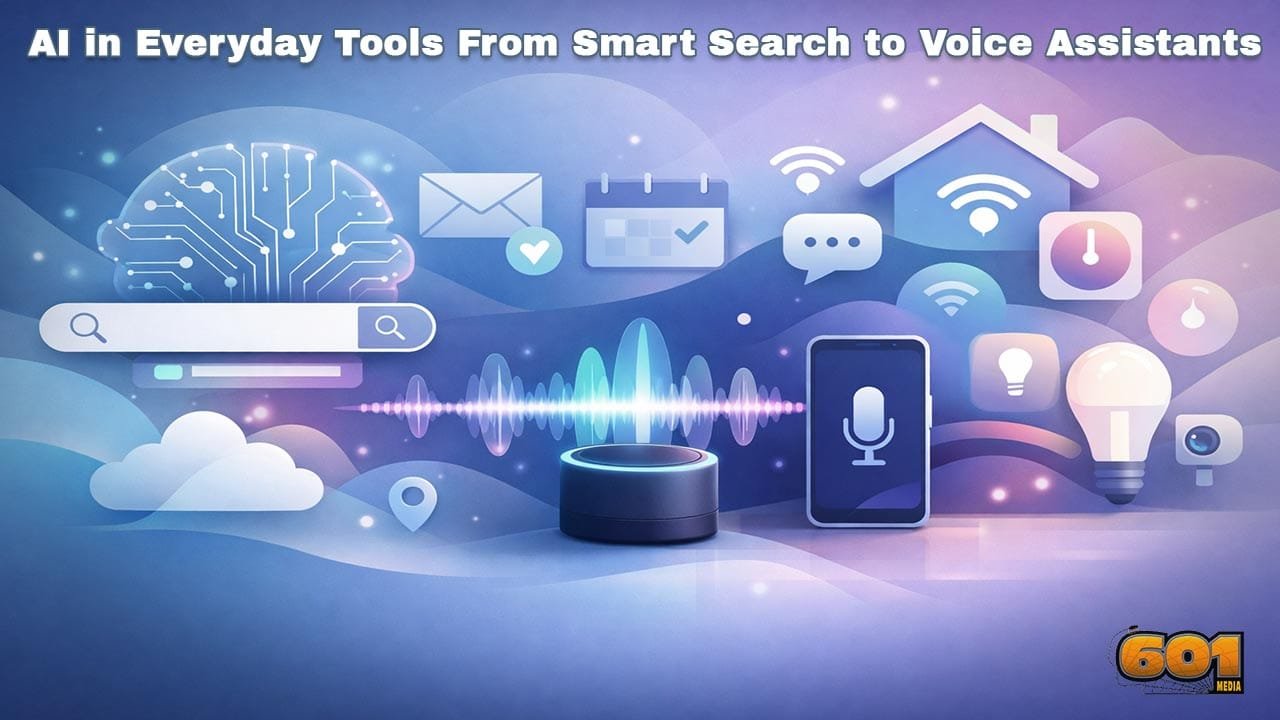
AI in Everyday Tools: From Smart Search to Voice Assistants
Artificial intelligence has quietly moved from research labs into the tools people use every hour of the day. Search engines now anticipate intent, email platforms finish sentences, and voice assistants manage calendars and control homes. This shift is not about futuristic machines but about embedded intelligence that improves speed, accuracy, and convenience in everyday digital experiences.
Table of Contents
- The Evolution of AI in Daily Digital Tools
- Smart Search: From Keywords to Intent
- AI in Productivity and Work Tools
- Voice Assistants as Everyday Interfaces
- Benefits and Trade-Offs for Consumers
- Implications for Businesses and Innovation
- The Future of AI-Driven Everyday Tools
- Top 5 Frequently Asked Questions
- Final Thoughts
- Resources
The Evolution of AI in Daily Digital Tools
Early digital tools followed rigid, rule-based logic. Users adapted to software limitations by learning commands, keywords, and structured inputs. The introduction of machine learning shifted this relationship. Tools began adapting to users instead. Modern AI systems learn from massive datasets, user behavior, and contextual signals. According to McKinsey, AI adoption in consumer-facing applications has grown at over 25 percent annually since 2019, driven largely by improvements in natural language processing and recommendation systems. This evolution has made AI largely invisible. Users no longer “use AI” consciously; they simply experience faster, smarter tools that feel intuitive.
Smart Search: From Keywords to Intent
Search engines represent one of the most mature examples of AI in everyday use. Early search relied on keyword matching. Today’s smart search systems interpret intent, context, and semantics. Natural language understanding allows users to ask full questions instead of typing fragmented phrases. AI models analyze location, search history, device type, and real-time signals to personalize results. Google reports that more than 15 percent of daily searches are entirely new, underscoring the need for adaptive AI rather than static indexing. Smart search now extends beyond the web. It powers in-app search, e-commerce product discovery, document retrieval, and enterprise knowledge bases. For users, this reduces friction. For businesses, it raises expectations around relevance and speed.
AI in Productivity and Work Tools
Everyday work tools increasingly rely on AI to reduce cognitive load. Email platforms use predictive text and spam filtering. Calendars suggest meeting times. Project management tools forecast deadlines based on historical patterns. Microsoft research shows that AI-assisted writing tools can reduce drafting time by up to 40 percent while improving clarity. These gains are not just about efficiency; they reshape how people allocate attention. Routine tasks become automated, allowing more focus on decision-making and creativity. However, this also introduces dependency risks. Over-reliance on AI suggestions may reduce critical thinking if users stop questioning outputs. Effective tool design balances automation with user control.
Voice Assistants as Everyday Interfaces
Voice assistants represent a major interface shift. Instead of navigating menus or screens, users interact conversationally. Advances in speech recognition and contextual understanding have pushed voice accuracy above 95 percent in controlled environments. Voice assistants now handle reminders, smart home controls, navigation, and real-time information retrieval. Adoption is driven by convenience, particularly in multitasking scenarios such as driving or cooking. From an innovation management perspective, voice assistants are platform technologies. They create ecosystems for third-party skills and services, influencing how consumers discover brands and content. This shifts competition from visual placement to conversational relevance.
Benefits and Trade-Offs for Consumers
AI-powered everyday tools deliver clear benefits. Tasks are completed faster, interfaces feel more natural, and personalization improves satisfaction. PwC estimates that AI-driven personalization increases customer engagement by up to 30 percent. The trade-offs center on privacy, transparency, and data control. These tools require continuous data collection to function effectively. Consumers often trade personal data for convenience without fully understanding the implications. Trust becomes a critical factor. Tools that clearly communicate how data is used and allow meaningful customization are more likely to achieve long-term adoption.
Implications for Businesses and Innovation
For businesses, AI in everyday tools raises the baseline for user experience. Intelligent features are no longer differentiators; they are expectations. Organizations must integrate AI not as a bolt-on feature but as a core capability. Innovation leaders focus on data quality, model governance, and cross-functional alignment. According to Gartner, by 2027, over 60 percent of consumer software features will be AI-driven, up from less than 20 percent in 2022. This shift also changes talent needs. Product teams require a blend of technical, ethical, and user-centered design expertise to deploy AI responsibly at scale.
The Future of AI-Driven Everyday Tools
The next phase of AI in everyday tools will emphasize contextual intelligence. Tools will anticipate needs across devices and environments, creating seamless experiences rather than isolated interactions. Multimodal AI, combining text, voice, vision, and behavioral data, will further blur boundaries between tools. The challenge will be maintaining human agency while increasing automation. Successful innovation will prioritize usefulness over novelty. AI that quietly removes friction will define the most valuable everyday tools of the next decade.
Top 5 Frequently Asked Questions
Final Thoughts
AI in everyday tools is not about replacing human intelligence but augmenting it. The most successful applications disappear into workflows, reducing friction while preserving user control. For consumers, this means more intuitive experiences. For organizations, it demands thoughtful innovation that balances performance, trust, and responsibility.
Resources
- McKinsey & Company – The State of AI Report
- Gartner – AI Software Market Forecast
- PwC – AI Consumer Intelligence Series
- Microsoft Research – AI and Productivity Studies

I am a huge enthusiast for Computers, AI, SEO-SEM, VFX, and Digital Audio-Graphics-Video. I’m a digital entrepreneur since 1992. Articles include AI researched information. Always Keep Learning! Notice: All content is published for educational and entertainment purposes only. NOT LIFE, HEALTH, SURVIVAL, FINANCIAL, BUSINESS, LEGAL OR ANY OTHER ADVICE. Learn more about Mark Mayo