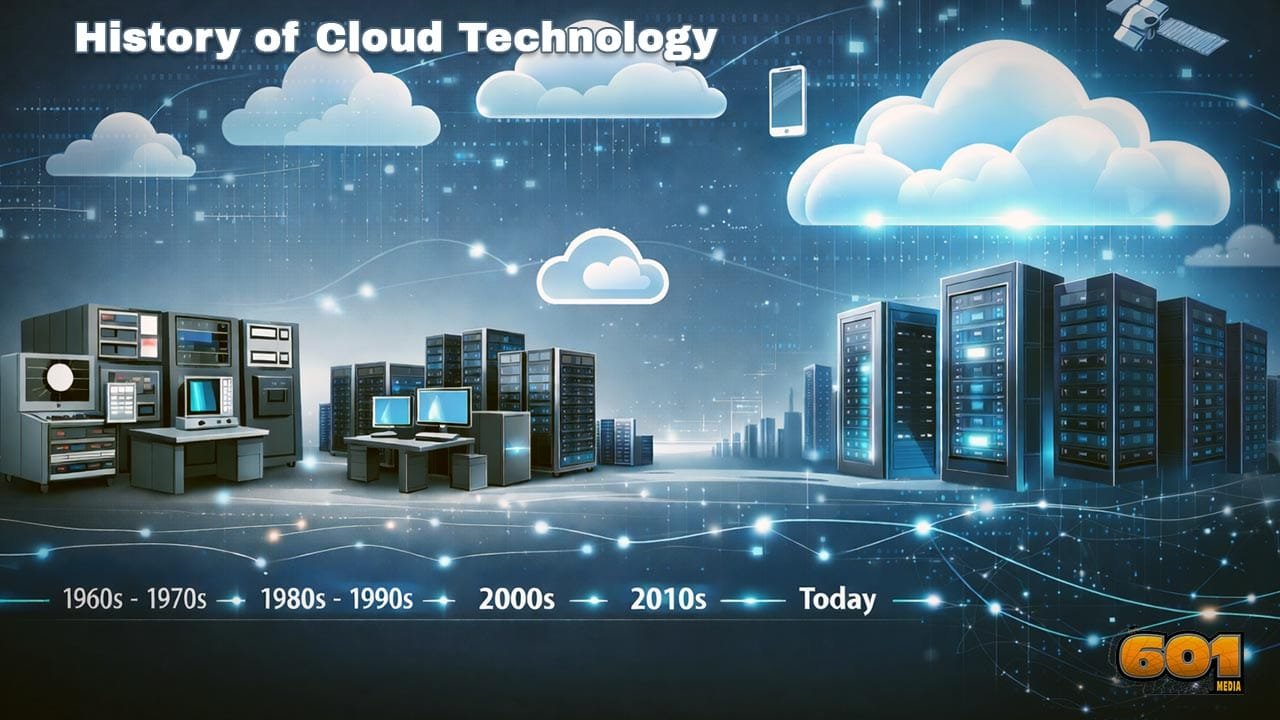
History of Cloud Technology — From Mainframes to Modern Cloud
A clear, end-to-end exploration of how cloud technology evolved from centralized mainframes into today’s elastic, on-demand cloud platforms, explaining the technical, economic, and managerial forces that shaped modern computing.
Table of Contents
- The Mainframe Era: Centralized Computing Begins
- The Rise of Client–Server Computing
- Virtualization: The True Precursor to Cloud
- Early Cloud Concepts and Utility Computing
- The Emergence of Public Cloud Platforms
- IaaS, PaaS, and SaaS Explained
- Modern Cloud: Containers, Serverless, and Edge
- Business and Innovation Impact
- What the Future of Cloud Technology Looks Like
- Top 5 Frequently Asked Questions
- Final Thoughts
- Resources
The Mainframe Era: Centralized Computing Begins
Cloud technology did not appear overnight. Its conceptual roots trace back to the 1950s and 1960s with the rise of mainframe computers. Mainframes were massive, expensive machines owned by governments, universities, and large enterprises. Because computing resources were scarce and costly, organizations centralized them and shared access among many users. Time-sharing systems allowed multiple users to interact with a single machine through terminals. This was a critical idea: computing as a shared utility. Users did not own the hardware; they consumed processing power when needed. From a technology management perspective, this model maximized asset utilization and justified high capital expenditure. However, mainframes were rigid. Scaling required purchasing larger machines, deployment cycles were slow, and innovation was constrained by vendor lock-in. These limitations eventually triggered a shift toward more distributed models.
The Rise of Client–Server Computing
During the 1980s and 1990s, personal computers and local area networks transformed computing architecture. Client–server models distributed workloads across smaller, cheaper servers while users interacted through desktop clients. This era emphasized ownership. Organizations bought servers, installed software on-premises, and managed everything internally. While this improved flexibility compared to mainframes, it introduced new inefficiencies. Server utilization often remained below 20 percent, according to industry studies, meaning most computing capacity sat idle. From an innovation management standpoint, IT became a bottleneck. Provisioning new servers took weeks or months, limiting experimentation and slowing digital transformation.
Virtualization: The True Precursor to Cloud
Virtualization changed everything. By abstracting hardware from software, virtualization allowed multiple virtual machines to run on a single physical server. This dramatically improved utilization, reduced costs, and simplified management.
Virtualization introduced three foundational cloud principles:
- Resource pooling across workloads
- Isolation between users and applications
- Rapid provisioning of computing environments
For technology leaders, virtualization shifted IT from hardware management to capacity management. It laid the groundwork for elastic infrastructure, a defining feature of cloud computing.
Early Cloud Concepts and Utility Computing
In the late 1990s and early 2000s, the idea of “utility computing” gained traction. The concept proposed that computing should be delivered like electricity: metered, on-demand, and scalable. Several early service providers attempted this model, but limitations in bandwidth, automation, and reliability slowed adoption. Nonetheless, these efforts clarified the business case: reduce capital expenditure, convert fixed costs into variable costs, and enable faster innovation cycles. This period also saw the rise of large-scale data centers optimized for efficiency, a prerequisite for modern cloud platforms.
The Emergence of Public Cloud Platforms
The mid-2000s marked a turning point. Advances in broadband, virtualization, and distributed systems enabled large providers to offer reliable, scalable cloud services to external customers. Public cloud platforms introduced self-service provisioning, pay-as-you-go pricing, and global infrastructure. For the first time, startups could access enterprise-grade computing resources without upfront investment. This democratization of technology accelerated innovation. Research from industry analysts shows that cloud adoption significantly reduced time-to-market for digital products and lowered barriers to entry across industries.
IaaS, PaaS, and SaaS Explained
Modern cloud services are commonly categorized into three models. Infrastructure as a Service provides virtualized computing resources such as servers, storage, and networking. It offers maximum flexibility but requires strong operational expertise. Platform as a Service abstracts infrastructure management and provides development frameworks, databases, and middleware. This enables teams to focus on application logic rather than system maintenance. Software as a Service delivers complete applications over the internet. Users consume functionality without worrying about infrastructure or updates. From a management perspective, these models represent a trade-off between control and speed. Organizations increasingly adopt hybrid strategies to balance innovation and governance.
Modern Cloud: Containers, Serverless, and Edge
Cloud technology continues to evolve. Containers standardized application packaging, making workloads portable across environments. Orchestration platforms automated deployment, scaling, and resilience. Serverless computing pushed abstraction further by eliminating server management entirely. Developers now write code that runs only when triggered, optimizing cost and scalability. Edge computing extends cloud capabilities closer to data sources, reducing latency for applications such as IoT, autonomous systems, and real-time analytics. Together, these innovations signal a shift from infrastructure-centric thinking to experience-centric computing.
Business and Innovation Impact
Cloud computing reshaped how organizations innovate. It supports rapid experimentation, continuous delivery, and data-driven decision-making. Studies consistently show higher innovation velocity among cloud-native organizations. From a strategic standpoint, cloud enables ecosystem participation. APIs, marketplaces, and platform partnerships thrive because cloud infrastructure supports interoperability at scale. However, cloud adoption also introduces challenges, including cost governance, security responsibility models, and skills gaps. Successful organizations treat cloud as a business transformation, not just a technology upgrade.
What the Future of Cloud Technology Looks Like
The future of cloud technology points toward increased automation, AI-driven infrastructure management, and tighter integration with intelligent systems. Cloud platforms are becoming adaptive environments that optimize themselves in real time. Sustainability is another emerging priority. Providers are investing heavily in energy-efficient data centers and carbon-aware workloads, aligning cloud strategy with environmental goals. Ultimately, cloud will continue evolving toward invisible infrastructure, where computing power fades into the background and innovation takes center stage.
Top 5 Frequently Asked Questions
Final Thoughts
The history of cloud technology is a story of abstraction, efficiency, and access. Each evolutionary step reduced friction between ideas and execution. For technology leaders, the most important takeaway is this: cloud is not a destination but a continuously evolving capability that reshapes how innovation happens.
Resources

I am a huge enthusiast for Computers, AI, SEO-SEM, VFX, and Digital Audio-Graphics-Video. I’m a digital entrepreneur since 1992. Articles include AI researched information. Always Keep Learning! Notice: All content is published for educational and entertainment purposes only. NOT LIFE, HEALTH, SURVIVAL, FINANCIAL, BUSINESS, LEGAL OR ANY OTHER ADVICE. Learn more about Mark Mayo