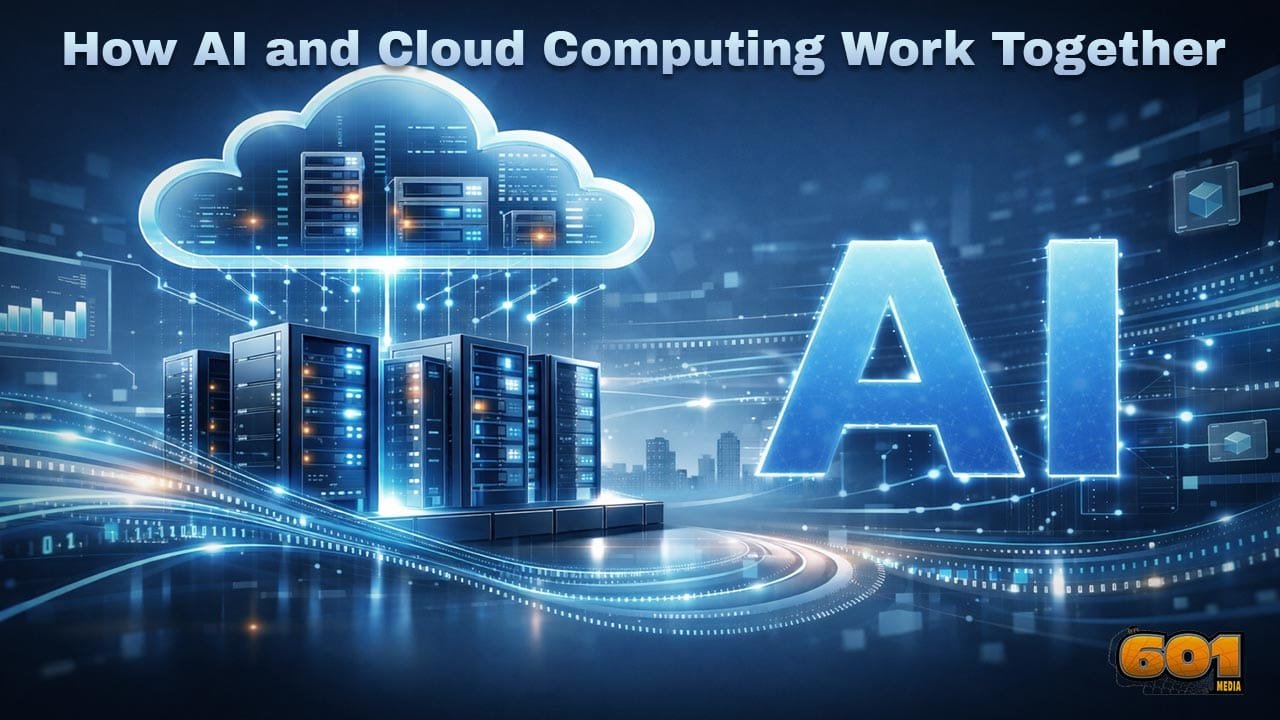
How AI and Cloud Computing Work Together
Artificial intelligence and cloud computing have become inseparable forces in modern digital transformation. Together, they enable organizations to build smarter systems, scale innovation faster, and reduce the cost and complexity traditionally associated with advanced computing. Today we explain how AI and cloud computing complement each other, why their convergence matters, and what it means for businesses, governments, and society.
Table of Contents
- Foundations of AI and Cloud Computing
- Why AI Needs the Cloud
- How Cloud Platforms Enhance AI Capabilities
- Real-World Use Cases Across Industries
- Reference Architecture: AI on the Cloud
- Key Challenges and Limitations
- The Future of AI–Cloud Convergence
- Top 5 Frequently Asked Questions
- Final Thoughts
- Resources
Foundations of AI and Cloud Computing
Artificial intelligence refers to systems capable of performing tasks that typically require human intelligence, such as perception, reasoning, learning, and decision-making. Modern AI is dominated by machine learning and deep learning, which rely heavily on data, mathematical models, and computational power.
Cloud computing, by contrast, is a delivery model for computing resources. Instead of owning physical servers and data centers, organizations access compute power, storage, networking, and software over the internet on a pay-as-you-go basis.
Individually, each technology delivers value. Together, they create a multiplier effect. AI supplies intelligence, while the cloud supplies elasticity, accessibility, and scale.
Why AI Needs the Cloud
Advanced AI systems are computationally intensive. Training a modern deep learning model can require thousands of processing cores running for days or weeks. Very few organizations can justify building this infrastructure on-premises.
The cloud solves this problem by offering virtually unlimited computing resources on demand. Organizations can spin up high-performance GPUs or specialized AI accelerators when needed and shut them down when training completes.
Data availability is another reason AI depends on the cloud. AI models improve with data volume and diversity. Cloud platforms centralize data from multiple sources, making it easier to store, clean, and process information at scale.
Finally, collaboration drives AI progress. Cloud-based environments allow globally distributed teams to develop, train, and deploy AI models using shared tools and datasets in real time.
How Cloud Platforms Enhance AI Capabilities
Cloud computing does more than provide raw infrastructure. It actively enhances AI development through managed services, automation, and integrated tooling.
Managed machine learning platforms abstract away much of the complexity involved in building AI systems. Tasks such as data preprocessing, model training, hyperparameter tuning, and deployment can be orchestrated automatically. This reduces time to value and lowers the barrier to entry for organizations without deep AI expertise.
Scalability is another core advantage. AI workloads are often bursty. Training requires massive compute resources for short periods, while inference may need to scale instantly to serve millions of users. Cloud elasticity ensures resources match demand precisely.
Security and compliance also benefit. Leading cloud providers invest billions annually in cybersecurity, encryption, identity management, and regulatory compliance. This level of protection is difficult for individual organizations to replicate.
Real-World Use Cases Across Industries
In healthcare, cloud-based AI supports medical imaging analysis, predictive diagnostics, and personalized treatment recommendations. Models trained in the cloud can analyze millions of patient records while maintaining compliance with data protection standards.
In finance, AI running on cloud platforms enables real-time fraud detection, algorithmic trading, and credit risk assessment. Cloud elasticity allows financial institutions to process transaction spikes without system degradation.
Manufacturing uses AI and cloud computing to power predictive maintenance and quality control. Sensor data streamed to the cloud is analyzed by machine learning models that detect anomalies before equipment fails.
Retail organizations leverage cloud-hosted AI for demand forecasting, dynamic pricing, and personalized customer experiences. The ability to process large datasets from online and in-store channels is critical to these capabilities.
Reference Architecture: AI on the Cloud
A typical AI-on-cloud architecture begins with data ingestion. Data flows from applications, devices, and external sources into cloud storage systems.
The next layer handles data processing and feature engineering. This stage cleans, transforms, and prepares data for machine learning models.
Model training occurs on scalable compute clusters equipped with CPUs, GPUs, or specialized accelerators. Once trained, models are deployed as cloud services accessible through APIs.
Finally, monitoring and feedback loops track model performance, detect drift, and trigger retraining when accuracy declines. This lifecycle approach ensures AI systems remain reliable and relevant over time.
Key Challenges and Limitations
Despite its advantages, the combination of AI and cloud computing introduces challenges. Cost management is a major concern. Poorly optimized AI workloads can generate unexpectedly high cloud bills.
Data privacy and sovereignty also remain critical issues. Organizations must ensure sensitive data is stored and processed in compliance with local regulations.
Vendor lock-in is another risk. Relying too heavily on proprietary cloud AI services can limit flexibility and increase switching costs.
Finally, skills gaps persist. While cloud platforms simplify AI development, organizations still need talent capable of understanding data, models, and business context.
The Future of AI–Cloud Convergence
The convergence of AI and cloud computing is accelerating. Edge computing is extending AI capabilities closer to data sources, while the cloud continues to serve as the central training and coordination hub.
Advances in automation will further simplify AI development, enabling non-experts to build intelligent applications. At the same time, regulatory and ethical considerations will shape how AI systems are deployed and governed.
In the long term, cloud-native AI will become the default model for innovation. Organizations that master this convergence will gain sustained competitive advantage.
Top 5 Frequently Asked Questions
Final Thoughts
The most important takeaway is that AI and cloud computing are not separate technologies but complementary layers of the same innovation stack. AI provides intelligence, while the cloud provides the scale, speed, and accessibility needed to operationalize that intelligence. Organizations that treat them as a unified strategy rather than isolated initiatives are best positioned to turn data into lasting value.
Resources
- National Institute of Standards and Technology – Artificial Intelligence Overview
- OECD – Artificial Intelligence and Cloud Computing Policy Reports
- McKinsey Global Institute – The State of AI
- Gartner Research – Cloud AI Platforms

I am a huge enthusiast for Computers, AI, SEO-SEM, VFX, and Digital Audio-Graphics-Video. I’m a digital entrepreneur since 1992. Articles include AI researched information. Always Keep Learning! Notice: All content is published for educational and entertainment purposes only. NOT LIFE, HEALTH, SURVIVAL, FINANCIAL, BUSINESS, LEGAL OR ANY OTHER ADVICE. Learn more about Mark Mayo